Choose fleet vehicles by their task and route, then compare a few exact configurations. Seat count, ride height and body style help narrow the choice but do not replace a site assessment.
For a useful first shortlist:
- Separate passenger transfers from maintenance and delivery work.
- Check peak group size, luggage and access before selecting a body length.
- Compare the exact seating layout, dimensions and cargo arrangement.
- Ask the supplier to confirm outstanding load, route and charging requirements in writing.
Match each task to a vehicle category
Use this matrix to open the relevant part of the vehicle catalogue. The category is a starting point; the final decision depends on the quoted configuration.
| Operating task | Category to compare | Confirm before shortlisting |
|---|---|---|
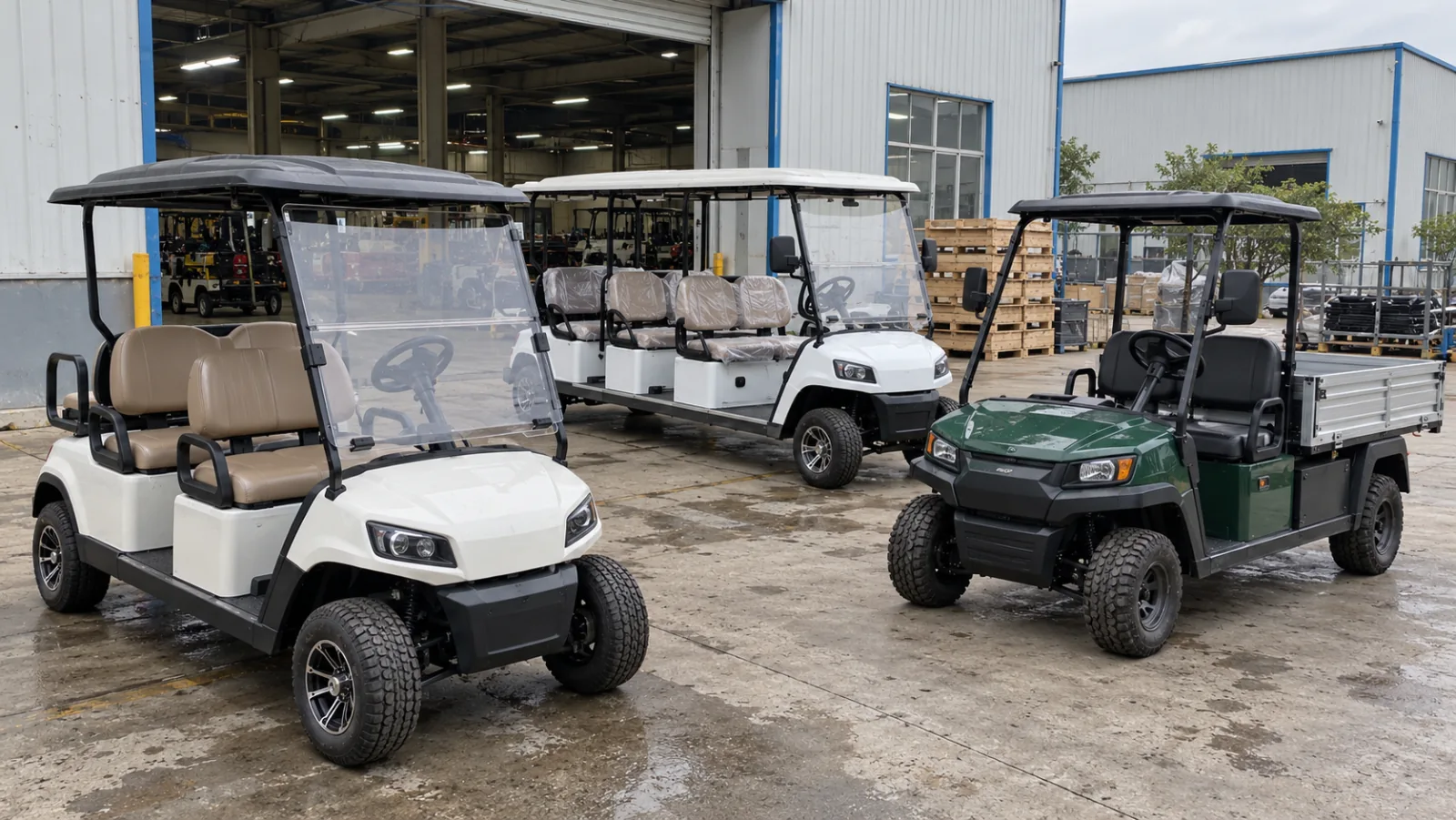
| Small-group guest or staff transfers | Golf carts | Seating arrangement, luggage location and access at each stop |
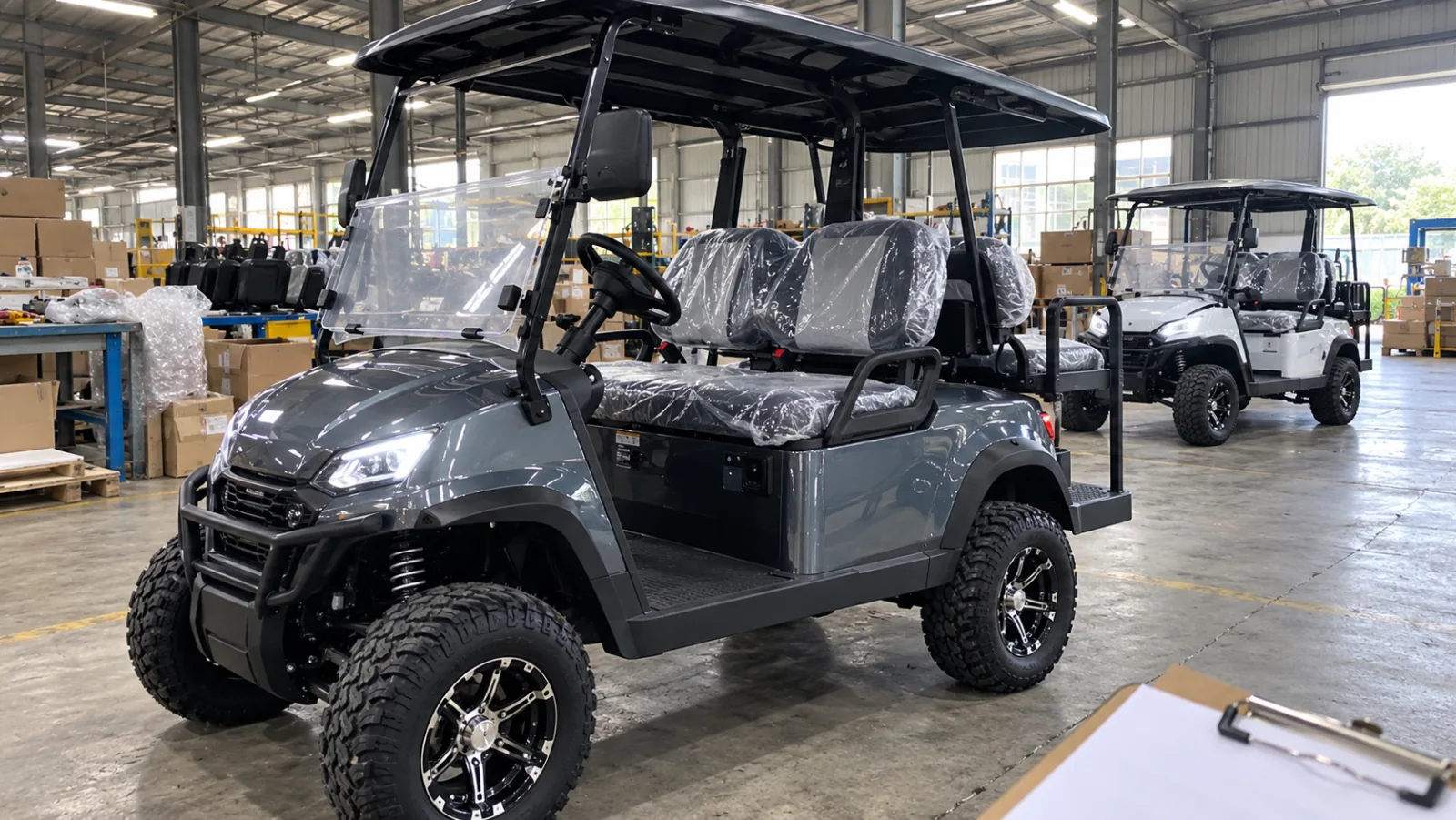
| Transfers involving gravel or unpaved service roads | Lifted carts | Surface and slope suitability, clearances and passenger boarding |
| Scheduled transfers for larger groups | Passenger shuttles | Peak group size, turning space, stopping area and open or enclosed body |
| Tools, supplies and back-of-house deliveries | Utility and cargo vehicles | Rated payload, cargo dimensions, loading method and body arrangement |
Raised ride height and all-terrain tyres do not establish suitability for every rough route. Send surface photographs and measurements for the chosen model. Assess an enclosed shuttle against boarding needs and quoted equipment as well.
Survey the whole route
Walk the route with the people who will operate the vehicles. Record the points that could rule out a configuration:
- Entrances: measure the narrowest opening, overhead obstruction and any gate that must close around the parked vehicle.
- Turns: photograph tight corners and record available manoeuvring space, including the approach to loading bays.
- Stops: identify where passengers wait, board and leave, and where luggage will be handled.
- Surfaces: describe paved, gravel, uneven and wet sections; record slopes for supplier review.
- Shared areas: mark pedestrian crossings, busy service doors and places where loading could obstruct another route.
- Storage: measure parking and charging spaces, with access for the operator and service team.
Compare published overall dimensions in the specification index, then request missing clearance or turning information. Overall width alone does not prove a vehicle can complete a turn or pass safely through a busy entrance.
Treat seats and luggage as separate requirements
A group of four people with bags presents a different task from four staff members travelling without equipment. Record both the number of passengers and the items that must travel with them. Ask where those items will be secured and whether the proposed arrangement changes the available seating.
For utility work, describe the largest item, expected load, loading frequency and whether goods need a particular body arrangement. Request the rated payload and usable cargo dimensions for that configuration. Two seats on a utility vehicle do not describe its cargo capacity, and additional passenger seats do not establish suitability for carrying tools or supplies.
Build a compact model shortlist
These examples show how published dimensions and capacity can narrow the discussion. They are comparison references, not recommendations for an unassessed site.
| Model | Published seats | Published width | Question to resolve |
|---|---|---|---|
| Cruiser C40 | 4–6 | 1260 mm | Which seating layout and luggage arrangement will be supplied? |
| Trailblazer GT TG45 | 4 | 1330 mm | Is the lifted configuration suitable for the surveyed route? |
| Transit TR8 | 8 | 1510 mm | Can the route and stops accommodate the selected shuttle body? |
| Hauler Compact HC20 | 2 | 1215 mm | What payload and cargo-body dimensions apply to the quotation? |
The C40 entry spans seating options; confirm the quoted layout. Compare length, height and equipment too. A narrower body still needs adequate turning, boarding and loading space.
Example: a hypothetical mixed fleet
Suppose a resort needs guest transfers, a group shuttle and maintenance deliveries. This hypothetical planning example is not a customer case study.
The operator could compare the C40 for smaller transfers, the TR8 for scheduled groups and the HC20 for tools and supplies. A gravel service route would justify a separate review of a lifted option such as the TG45. Each remains conditional on the route survey and the supplier’s configuration confirmation.
Record trip frequency and overlapping demands before deciding quantities. A shuttle serving a group cannot cover another transfer simultaneously. Separate goods vehicles may simplify scheduling, while a mixed fleet needs parts and service planning for each configuration.
Check the schedule before requesting a quotation
For each shortlisted vehicle, record working hours, distance, busiest shift and available charging periods. Include seasonal peaks and any period when a vehicle is unavailable. Ask the supplier to review the proposed battery and charger against that schedule; a published range figure does not establish your site’s daily operating result.
Send the model names, quantities, route notes and unresolved questions through the fleet enquiry form. For route photographs, use the email option on the contact page. Use the fleet buying checklist to organise the quotation request and the battery planning guide for the charging brief.
Frequently asked questions
Can one model cover passengers and maintenance work?
Possibly, but start by listing overlapping tasks and the required seating and cargo arrangements. Ask the supplier whether the exact configuration meets both briefs. Do not infer payload or safe goods storage from passenger capacity.
Should I choose the vehicle with the most seats?
Compare group size with trip frequency, luggage and route access first. More seats may change the body dimensions and stopping requirements. Confirm the supplied seating layout and assess the complete vehicle against the route.
Does a lifted cart qualify for public-road use?
Ride height and category do not establish road-use approval. See the buyer FAQ and request the documentation for the exact configuration before checking the requirements in your destination market.
Sources and scope
Model names, seating and widths above come from the catalogue and specification index, based on the manufacturer’s 2025 model-year sheets, revision 20250901. These are published first-party specifications, not independent validation. Confirm the current supplied specification, rated payload, included equipment and route suitability before ordering. The task matrix and resort example are planning aids; they do not certify a vehicle for a particular site.
For a property timetable, use the hotel shuttle sizing guide to separate peak passenger demand from charging and standby needs.
← Back to all guides